


This page was last revised for version 4.2.0.
Please help us to keep up-to-date documentation by editing this page directly to fill in any documentation gap. Do reach out if you need assistance!
Modeling in SNT is performed through Cortex3D (Cx3D) and sciview. Cx3D was developed in 2009 as a computational modeling tool for simulating neurodevelopmental processes, including cell division, migration, neurite outgrowth, and chemotaxis in 3D physical space. It is well known for generative models of cortical circuits.
Unlike electrophysiology simulators (e.g., NEURON), Cx3D operates at the developmental time scale: it models how neurons grow and wire up, not how they fire. The Morphonets distribution of Cx3D was modified by Kyle Harrington to be compatible with SNT. This includes using sciview for 3D visualization, and support for image-based modeling.
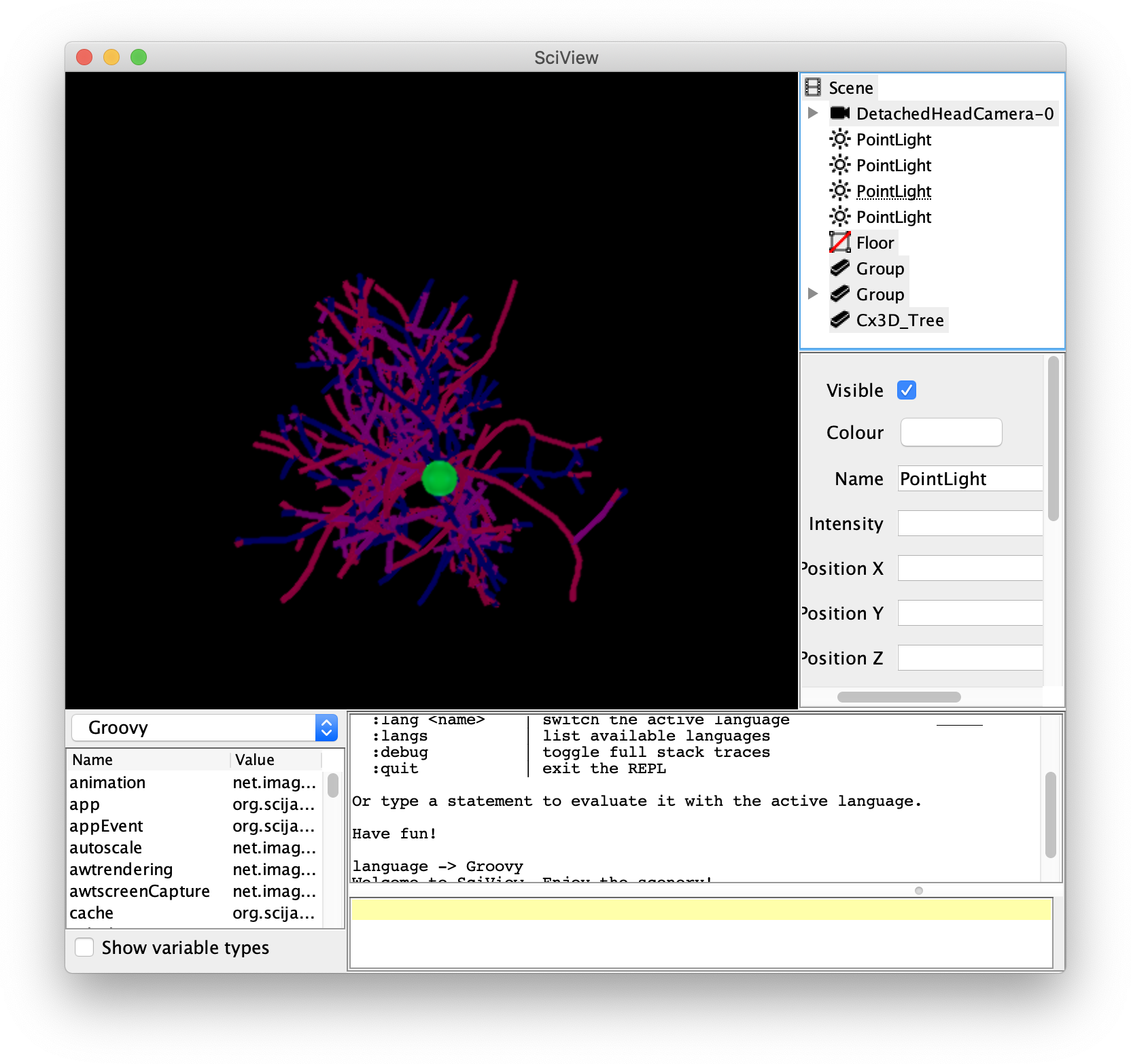
Synthetic neuron generated using the Random Branching demo, accessible from sciview’s Demo menu.
Key Capabilities
- Morphogenesis: Cells divide, migrate, and grow neurites in a 3D physical space governed by mechanical forces and chemical gradients
- Agent-based: Each cell follows local rules; emergent network structure arises from those rules
- Developmental time scales: Hours/days of neurodevelopment
- Encoded environmental cues: Cues like chemical gradients/forces can be encoded by imagery
NB: Membrane biophysics and related cable equations are not considered in Cx3D simulations
Custom Models
Currently, an IDE is the most effective way to implement custom models, using the minimal-cx3d-example-project as a template. For more information refer to the GitHub project page.